A1 poster size
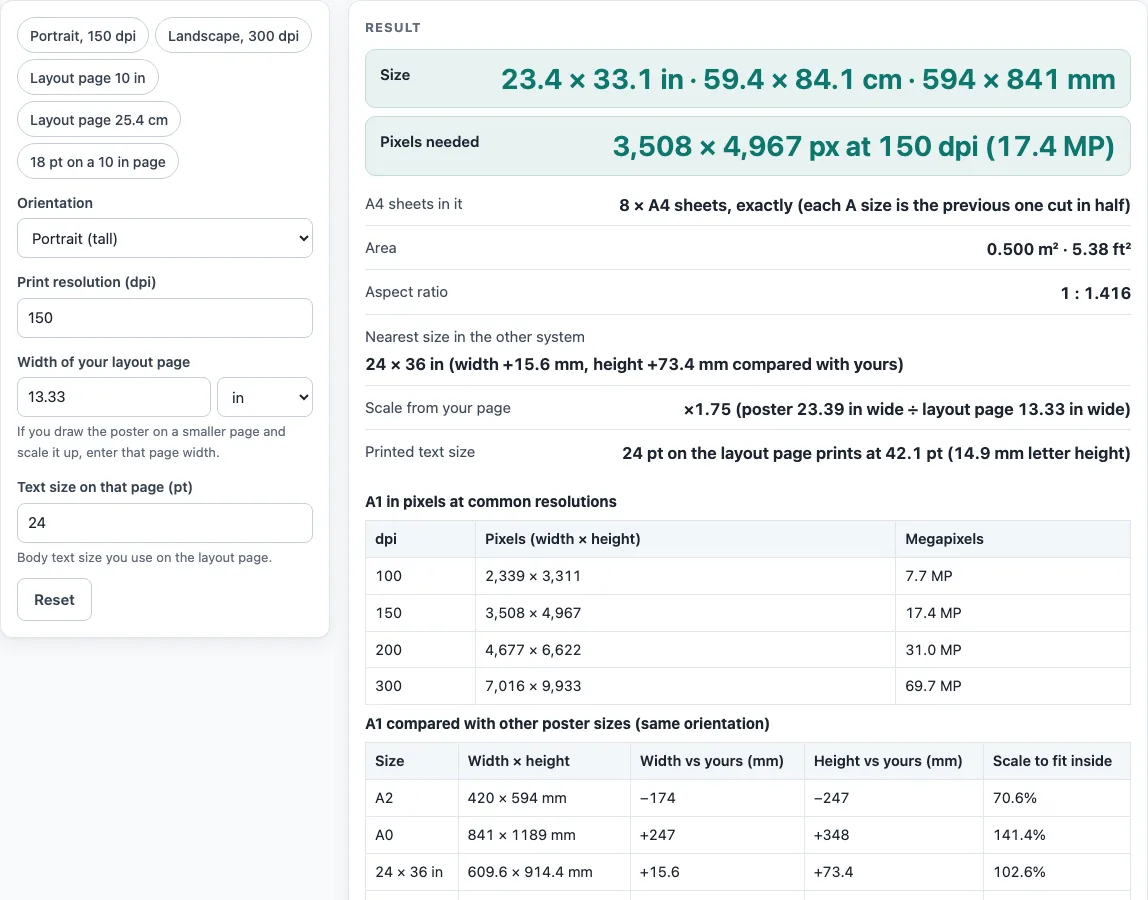
A1 is 594 x 841 mm. Choose orientation and dpi to get the pixels, and enter your layout page width to see how text scales.
Recent
Your last 10 settings, saved only in this browser. Nothing is uploaded.
How to use the A1 poster size tool
- Choose portrait or landscape. The size stays 594 x 841 mm either way.
- Set the print resolution in dpi. The default is 150. The presets “portrait 150 dpi” and “landscape 300 dpi” fill in both settings. Values from 10 to 2400 are allowed, and values under 100 or over 600 show a warning.
- Enter the width of your layout page, the smaller page you draw on. The default is 13.33 in. The presets “layout page 10 in” and “layout page 25.4 cm” are available. The width must be above zero.
- Enter the text size in points. The default is 24 pt, and the form takes 1 to 1000 pt.
- Read the size block for inches, cm and mm, the aspect ratio and the area.
- Check the pixels needed at your dpi. The second table lists 100, 150, 200 and 300 dpi.
- Read the scale and the printed text size. On a 10 in layout page the scale is 2.34, so 24 pt text prints at 56.1 pt.
- Use the board table as a reference only. It repeats what each event page published, and those pages change, so check the current guide before you submit.
The tool shows an error for a non-number, a page width of zero or less, dpi outside 10 to 2400, or a text size outside 1 to 1000 pt. The “18 pt on a 10 in page” preset fills in a common text example in one step.
What are the exact dimensions of the A1 poster size?
A1 is 594 x 841 mm. It belongs to the ISO 216 series, where A0 is 841 x 1189 mm, A2 is 420 x 594 mm and A4 is 210 x 297 mm. Every size in the series has the same ratio of 1 : 1.414, and each one is the previous size cut in half. A1 is therefore exactly 8 x A4 in area. Its area is 0.4996 m2, shown as 0.500, and its ratio from the figures is 841/594 = 1 : 1.416, a small difference from rounding.
The tool converts millimetres to inches using 1 in = 25.4 mm exactly, as set out by NIST SP 811. Pixels are found by multiplying inches by dpi and rounding. At 150 dpi, A1 needs 3,508 x 4,967 px. At 100 dpi it needs 2,339 x 3,311 px, at 200 dpi 4,677 x 6,622 px, and at 300 dpi 7,016 x 9,933 px.
Inch-based sizes do not always match the A series, and the nearest-size line in the results shows the mm difference. The “36x48 poster” keyword is used for both 36 wide x 48 tall and 48 wide x 36 tall. A0 (33.11 x 46.81 in) is not 36 x 48 in: 36 x 48 in is 73.4 mm wider and 30.2 mm taller than A0, and the comparison table lists these differences for the sizes it names.
How do scale and printed text size work for the A1 poster size?
The scale is the poster width divided by the layout page width. A text size in points on the layout page is multiplied by that scale. The letter height in mm is points / 72 x 25.4. In the worked example, A1 on a 10 in wide layout page gives a scale of 2.34, so 24 pt text prints at 56.1 pt. A scale under 1 means the layout page is wider than the poster, and the tool shows a warning.
Compared with A0, A1 is 247 mm narrower and 348 mm shorter. The comparison table shows the scale at which each listed size fits this poster.
Event pages do not always agree. Berkeley CTML recommends 30 x 40 in but allows up to 42 x 42 in, the HFES board space is 42 x 42 in, and one postpartum page allows 48 x 48 in. The ICPRP/IIUM poster (95 x 120 cm, up to 150 cm high) and the ISSBD recommended size (90 x 150 cm) are both portrait but differ, so both are listed side by side. The HFES sheet gives 42 in as “106.68 cm” once and “160.68 cm” elsewhere, and the tool uses 42 in only. Event rules change, so read the current guide for your own event.
Worked examples
| Input | Result |
|---|---|
| portrait, 150 dpi, layout page 13.33 in wide | 3,508 × 4,967 px; text scale ×1.75 |
| landscape, 300 dpi, layout page 13.33 in wide | 9,933 × 7,016 px; text scale ×2.48 |
| portrait, 150 dpi, layout page 10 in wide | 3,508 × 4,967 px; text scale ×2.34 |
Calculated by the tool above; open it with the same values to see each step.
Frequently asked questions
How many A4 sheets fit on an A1 poster?
Exactly 8. A1 is 8 times the area of A4, so the tool reports 8 A4 sheets for this size.
Is the A1 poster size portrait or landscape?
It can be either. The size stays fixed at 594 x 841 mm, and you choose the orientation in the tool.
Does the tool say whether an event takes an A1 poster?
No. This tool does not say whether a poster suits any event. Its results are calculated from your inputs, and the board table only repeats what each event page published. Check the event’s current author guide before you submit.
Why does the 36x48 keyword show two orientations?
The “36x48 poster” keyword is used for both 36 wide x 48 tall and 48 wide x 36 tall, so the page shows both. IEEE and the MiALA board describe the landscape version.
What dpi should I enter?
The default is 150 dpi, and the tool shows the pixels for 100, 150, 200 and 300 dpi. The page does not set a required value, so check what your printer or the event’s current guide asks for.
Why does my scale show a warning?
The scale is under 1 when your layout page is wider than the poster. Enter a narrower layout page width to get a scale of 1 or more.
Related tools
- 36x48 poster: use this when your board is one of the 36 x 48 inch sizes and you need to check the orientation.
- A0 poster size: use this to compare the next size up in the ISO series.
- A2 poster size: use this to compare the next size down in the ISO series.
- Conference poster size: use this to see the sizes that conference pages published.
- Poster dimensions: use this to compare widths and heights across common poster sizes.
- Poster Font Size Calculator: use this to work out text sizes for a poster you have scaled.
- Research poster template: use this when you are laying out a research poster.
- Scientific poster size: use this to check a size against scientific poster guidance.